Archive for the ‘Electricity’ Category

h1

Danish wind power ♥s Norwegian hydropower

April 6, 2012

Michael Giberson

From time to time a promoter of wind power will encourage the U.S. to follow Denmark’s lead and aim for a much higher levels of wind power on the grid. (Recently Denmark’s legislature established a goal of attaining 50 percent of its energy from wind power by 2020.)

A working paper by Johannes Mauritzen explains one of the key factors supporting Denmark’s current wind power capability: the flexibility inherent in Norway’s vast hydro-power capability. Mauritzen’s abstract:

It is well established within both the economics and power system engineering literature that hydro power can act as a complement to large amounts of intermittent energy. In particular hydro power can act as a “battery” where large amounts of wind power are installed. In this paper I use simple distributed lag models with data from Denmark and Norway. I find that increased wind power in Denmark causes increased marginal exports to Norway and that this effect is larger during periods of net exports when it is difficult to displace local production. Increased wind power can also be shown to slightly reduce prices in southern Norway in the short run. Finally, I estimate that as much as 40 percent of wind power produced in Denmark is stored in Norwegian hydro power magazines.

So, a first step for the United States renewable power policy might be to pick up and move the country a little closer to Norway.

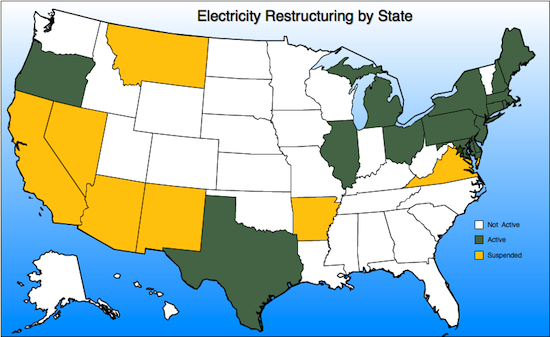
Less facetiously, and projecting a little bit, we might casually infer that the New York power market won’t have too much trouble with a moderate amount of wind power since it also has access to a lot of hydro-power. (11 percent of generating capacity is hydro and another 4 percent is pumped hydro, plus it imports hydro-power from Quebec.) Similarly, we might be more puzzled about all of the difficulties that power system administrators in the Pacific Northwest are having integrating wind into the regional grid, given the extensive hydro-power resources available. (With hydro about 2/3rds of the electric capacity in the region.) Finally, we might be still more surprised by the relative growth of wind power in Texas, which has relatively little hydro-power capacity on its system. (About 0.6 percent of capacity.)

Admittedly, the thing that a mostly-uncontrollable, variable-output technology like wind needs isn’t hydro-power per se, but rather a certain amount of flexibility and control within the power system it is connected to. The necessary flexibility is one part technology and one part power system rules.

The Nordic power system has both the technical means and the supportive power market rules, same for New York, and same for the ERCOT market in Texas (only in Texas the “technical means” are not hydro-power, but rather fast-ramping gas generation along with other resources over which the market has some control).

The Pacific Northwest has tons of flexible capability on the technical side of things* and it has the federal Bonneville Power Administration on the power system rules side of things. Yet somehow the combination of lots of capability and federal agency management produces as much conflict as cooperation.

*About the only caveat in BPA’s defense is that, to some degree, many competing claims to that technical flexibility have already been granted to non-power system users of the water resources involved in the form of environmental constraints, irrigation demands, treaty obligations with Native American organizations, and so on. Maybe the residual flexibility is smaller than it appears.

h1

RTO forward capacity markets are unlikely to succeed

April 6, 2012

Michael Giberson

The Gulf Coast Power Association meetings earlier this week included a debate over the future of resource adequacy within the ERCOT power system. Debate moderator Eric Schubert, BP Energy Company, introduced the issue with a critique of capacity market structures that is heavy on its reliance on Hayek’s knowledge problem. It is a topic dear to our heart here at the Knowledge Problem blog, so I thought we’d share a bit of it.

Here’s Schubert:

Hayek’s “Knowledge Problem” and its optimal solution – decentralized commercial markets – provide the best lens for regulators to see the fundamental issue in electricity market design in response to rapid technological change and increasingly diverse groups of buyers and sellers. As the procurement and use of electricity cross a complexity threshold, as a few customer classes are transformed into a multitude of individual market participants, the electricity market design needs to move away from centralized planning to a decentralized procurement of resources, to be both sustainable and efficient.

… In trying to adapt the centralized forward capacity mechanism to changing market and technological conditions, regulators and RTOs play a never-ending game of “whack-a-mole” because they can never overcome the “Knowledge Problem.” Even worse, under centralized procurement or any type of explicit “top-down” procurement of new resources mandated by regulators, unintended consequences of centralized procurements arise at the speed of markets and are corrected at the speed of administrative law.

Both long-standing economic theory and recent economic practice suggest that centralized forward capacity mechanisms are very unlikely to succeed. If they fail, state and federal regulators in the US will be forced to choose between the two known solutions to the “Knowledge Problem”:

  • A return to full integrated resource planning conducted by regulators, or
  • A move to fully decentralized wholesale and retail markets where individual customers make their own choices.

… Integrated resource planning, however, solves the “Knowledge Problem” by suppressing it. Having regulators in charge of integrating 21st century technologies would prevent consumers, retailers, and other market participants from using their local knowledge and ingenuity to find the next killer app or great idea that would provide all of us cleaner, more efficient and thoughtful use of energy. Or put another way, would we even have I-Phones today if regulators had never broken up Ma Bell?

[The alternative approach is that] with the proper price signals, buyers and sellers in ERCOT’s energy-only market will procure and manage sufficient resources to meet their individual needs and preferences while keeping the market resource adequate. Such decentralization of decision-making is the most efficient solution to the “Knowledge Problem.” The challenge of this path, however, is keeping the lights on during the transition; none of us can fully understand at this moment how the integration of the new technologies will happen, and what new ways of doing business and managing electricity use will spontaneously emerge over time.

By the way, in that first ellipsis I excised a reference to and quote from a great paper by Kenneth Rose that takes a detailed look at RTO capacity market structures.

Schubert’s full introduction is publicly available on the GCPA website, but only for the next month or so. Get it while it’s hot (and available).

h1

Net metering in Indiana sees exciting 50 percent growth

April 3, 2012

Michael Giberson

From the Indianapolis Star, “More Hoosiers reap benefits of generating their own electricity“:

[M]ore and more people around Indiana are starting to generate their own electricity, motivated by environmental concerns and feelings of energy independence.

The arrangement is known as “net metering,” allowing customers to offset part of their energy costs and feed the excess back to the utility for credit.

From 2010 to 2011, the number of Indiana customers taking part in net metering rose from 199 to 298 — a 50 percent increase, according to the Indiana Utility Regulatory Commission.

Sounds exciting, right? Okay, granted that in a state with about 2.6 million eligible retail electric customers, a move from  0.7 one-hundredths of one percent up to 1.2 one-hundredths of one percent of customers is not exactly a big deal.

The “big” jump in participation came mostly because the state allowed commercial and industrial customers to participate along with residential customers.

But at least a few customers are getting a great deal, right?

The system was expensive, about $30,000, or about as much as a new car. And so far, the savings are relatively modest, a few hundred dollars a year. So even with federal tax credits and a small grant from IPL, the system will take decades to pay for itself.

Decades to pay for itself, for a system with a projected lifespan of maybe two and a half  or three decades tops.

h1

Getting a little LED off my chest

March 23, 2012

You know what? I’d happily spend the $27.98 for the 6 LED chandelier bulbs at Costco IF THEY WERE DIMMABLE. Yes, I know I’m shouting, but crikey, if you want people to use less energy, MAKE IT EASIER FOR THEM. Seriously, electronics engineers, what’s the problem? Who on earth thinks that people want to sit under a brightly-lit chandelier without being able to change the lighting level?

Until you have good quality dimmable LED bulbs on the market, you’ll pry my incandescent chandelier (and can light) bulbs at your peril from my cold, dead hands.

h1

Innovative retail competition: is it finally starting … and in Chicago?

March 21, 2012

Lynne Kiesling

This may be the beginning of what I’ve been arguing for over the past decade plus … today in Smart Grid News, Jesse Berst reports that Constellation Energy has teamed up with Best Buy to enable customers to come into the store, switch their retail provider, and buy home energy management devices (see also the brief note in the Chicago Tribune). Jesse observes that

It has been fascinating to watch power retailing develop in areas such as Texas and the United Kingdom. In the early days, we thought it would be all about price. As it turns out, price is important but it is just the table stakes. To become a market leader, you have to establish brand trust. You have to bundle the power with other products or benefits. And you have to make that bundle ultra-easy to find and purchase.

Absolutely correct. This is the kind of Schumpeterian retail innovation that is a value-creating hallmark of competitive rivalry.

At first blush it also has some similarities with mobile phone retailing — I presume that the retail provider to which a customer can switch is Constellation, and not Direct Energy or any of the other retail providers in the Illinois residential market. I’ll be interested in seeing if Best Buy is willing to make similar arrangements with those retailers. If their contract with Constellation precludes such arrangements, then we run into the murky area of whether or not exclusive dealing contracts are anti-competitive. But if, say, Target strikes a deal with Direct Energy, and Costco and Walmart get in on this innovation, then the retail landscape really starts to look like mobile communications retailing, and things get very interesting.

Note also that this type of market channel is a way for consumers to learn, which is a crucial process in the liberalization of retail sales in an industry that has been vertically integrated and regulated for over a century. Regulation defines product characteristics and boundaries and thus determines the type of product that the consumer is purchasing, so for over a century residential customers haven’t had to think about what they are buying and whether there are ways for them to get more value out of the transaction and relationship. They had no choice, so why give it any thought? Now starts the process of individuals learning how and why they may create more and different value from changing their retail relationship and changing the technology they use in the purchase and management of the electricity they consume.

As it happens, the Best Buy in this pilot is my neighborhood store, so I’ll check it out and report back what’s interesting and important. Free the electricity consumer!

h1

How fear affects policy: Adam Thierer on technopanics

March 14, 2012

Lynne Kiesling

Fear is a strong motivating factor, having evolved over millennia as we have protected ourselves against predators. Fear supports self-preservation by making us risk-averse and cautious. But such a deep, visceral, evolved emotion does not always serve our long-term objectives of thriving; it leads to maximin outcomes, and it is often mismatched to the actual threats to our self-preservation. As our environments change around us, we can fear things we shouldn’t and may not fear things that we should; we overthink everything and tend toward a “precautionary principle” approach, making us risk-averse and cautious.

I think such fear is a component in the persistence of regulation when it’s maladaptive to technological change, so I was happy to read Adam Thierer’s new Mercatus working paper, Technopanics, Threat Inflation, and the Danger of an Information Technology Precautionary Principle. Adam lays out a framework for analyzing fear-based attitudes toward technology and technological change that’s informed by economics, sociology, psychology, and rhetoric. He tackles the question of why, and how, participants in public policy debates use appeals to fear to sway opinion toward anticipatory regulation and forms of censorship:

While cyberspace has its fair share of troubles and troublemakers, there is no evidence that the Internet is leading to greater problems for society than previous technologies did. That has not stopped some from suggesting there are reasons to be particularly fearful of the Internet and new digital technologies. There are various individual and institutional factors at work that perpetuate fear-based reasoning and tactics.

He analyzes the use of “appeal to fear” and “appeal to force” logic in the construction of arguments in favor of regulation and censorship, focusing on case studies of online child safety and violent media and online privacy and cybersecurity. In deconstructing these arguments he identifies four ways that fear can be a myth: it may be empirically unfounded and lacking evidence, other variables may be more important in affecting behavior than the feared variable, not all individuals have the same reaction to the feared variable, and other approaches than regulation exist that can mitigate the consequences of the feared variable (pp. 5-6).

Adam introduces the phenomenon of the “technopanic”, which is “… a moral panic centered on societal fears about a particular contemporary technology” (p. 7). Because culture often evolves more slowly than technology, as we are adapting culturally to the new technology we can see these panic phenomena, which can result in demonizing the technology and can lead to calls to “do something”, typically some form of control-based anticipatory regulation or censorship. A crucial part of manipulating individual attitudes to tap into fear and create advocacy for and acceptance of such regulation is what Adam calls “threat inflation”:

Thus, fear appeals are facilitated by the use of threat inflation. Specifically, threat inflation involves the use of fear-inducing rhetoric to inflate artificially the potential harm a new development or technology poses to certain classes of the population, especially children, or to society or the economy at large. These rhetorical flourishes are empirically false or at least greatly blown out of proportion relative to the risk in question. (p. 9)

Allowing threat inflation and technopanics to drive policy outcomes is socially corrosive and wasteful; it diverts resources from their higher-valued uses in dealing with actual risks rather than inflated ones, and it creates an environment of suspicion and social control, particularly censorship and information control. After analyzing six factors that create conditions favorable for the development of threat inflation and technopanics regarding Internet technology (nostalgia, special interests, etc., well worth reading in detail), he proposes two categories of policy response that we should pursue instead of prohibition and anticipatory regulation: resiliency and adaptation. We build resiliency to threats through education, transparency, labeling, etc., and we adapt to living with risk through experimentation, trial-and-error, experience, and social norms. These two are complementary; information-sharing about best practices can shape social norms and get people to change their behavior without regulation. For example, I don’t sign my credit cards, but instead write “CHECK ID” in the signature line and present a photo ID when using them. Having store clerks and other shoppers witness my behavior to protect my identity may lead to their replication of it, and has led over time to a change in behavior (remember back in the 1990s when they used to write your phone number on the receipt? Yikes! But that behavior’s gone extinct.).

We cannot eliminate risk through resilience and adaptation, but we can’t eliminate it through regulation either. Better to have strong, flexible, adaptable institutions and practices that enable us to continue thriving in unknown and changing conditions, while we enjoy the substantial benefits of technological creativity. While I heartily recommend Adam’s paper to you all as a good and thought-provoking read, he also summarizes it in this recent Forbes column.

I would extend Adam’s argument to apply to two case studies. The first is smart grid technology. Fear-based arguments abound in electricity, usually grounded (pun intended!) in the physical reality that electricity is dangerous. But after a century of economic regulation to serve particular social policy objectives, fear-based arguments also show up in arguments against moving away from the status quo both technologically and more economically in general; in my experience these fear-based arguments are used most to advocate for the status quo on behalf of low-income consumers and the elderly, and for that reason I find the use of fear-based arguments heart-wrenching, because when they succeed they deprive vulnerable populations of the benefits of innovation. Another current example is the arguments that digital meters, which transmit data using radio frequency wireless networks and thus emit low-level electromagnetic fields, are making people sick. Despite the absence of any scientific evidence consistent with this hypothesis, California and Maine are using these fear-based claims as a basis for allowing customers to opt out of having a digital meter installed (I have other analyses of this phenomenon, but that’s for another time …).

The second case is threat inflation and the exaggeration of fear to extend the security state. Each of Adam’s six factors contributing to threat inflation is applicable to the growth of the security state — nostalgia, pessimistic bias, “bad news sells”, the political power of the military-security-industrial complex, and so on. The persistence of threat inflation enables these special interests to use fear-based arguments to perpetuate the false belief that we are under constant, persistent threat beyond the actual threat level; this false belief creates the incentives in politicians to “do something” so that they don’t appear “soft on terror” and therefore risk not getting reelected; that political incentive enables security and defense companies to lobby politicians to buy their cutting-edge technologies at very great taxpayer expense to demonstrate to voters that they are “doing something” (even though the technologies have high false positive rates, can be fooled easily, and are more for symbolic security theater than for addressing the most relevant risks that we actually do face).

In both cases, a resiliency-oriented public policy approach would be a substantial improvement on the control-oriented regulation that is not focused on the most meaningful or relevant threats, be they health threats, economic threats, or security threats, from technological dynamism.

h1

The WSJ’s awful editorial against the wind power industry

March 8, 2012

Michael Giberson

Like the editorial board of the Wall Street Journal, I’d like to see the Production Tax Credit for wind and other renewable energy technologies expire at the end of this year as scheduled. So policy-wise, I’m with them. Still, their editorial against the wind power policy yesterday was awful and it deserves public criticism.

So here are quotes from the WSJ in italics, followed by my comments.

“The renewable energy tax credit—mostly for wind and solar power—started in 1992 as a ‘temporary’ benefit for an infant industry.”

Stick with “mostly for wind.” Other technologies qualify, too, including a variety of hydroelectric technologies and geothermal power, but not currently solar power.

Solar was briefly included in the PTC through the American Jobs Creation Act of 2004, but then was back out at the end of 2005. Solar power benefits from the Investment Tax Credit, and until December 2011 benefited from “Section 1603″ cash grants in lieu of the ITC.

If you’re tempted to argue they said “renewable energy tax credits”, not specifically the PTC, note that they clearly say the renewable energy tax credits that began back in 1992 (in that year’s Energy Policy Act) – they’re talking about the PTC and they get the solar reference wrong.

Details on the PTC, via DSIRE.

“The ’1603 grant program’ pays up to 30% of the construction costs for renewable energy plants …. Wind producers then get the 2.2% tax credit for every kilowatt of electricity generated.”

No. To get the 1603 cash grant a developer has to forgo the Production Tax Credit. One or the other, but not both.

And for crying out loud, it is a 2.2 cents/kwh tax credit, not a “2.2% tax credit.” The Heritage Foundation can get this right, you’d think the WSJ could do as well.

(Or, more precisely, that was last year’s subsidy but the PTC is adjusted annually for the effects of inflation so in 2012 it will be slightly higher.)

… and Senator Jeff Bingaman of New Mexico has introduced a national renewable-energy mandate so consumers will be required to buy wind and solar power no matter how high the cost.

I didn’t notice this problem myself, not having dug through the details of the bill Sen. Bingaman introduced last week, but Richard Caperton and Stephen Lacey at Climate Progress point out that the bill caps the cost increase at 3 cents/kwh.

These sloppy errors don’t mean the WSJ is wrong, only that they’re willing to publish poorly researched opinion pieces.

The Caperton and Lacey post at the Climate Progress blog mentioned the above errors and raised some additional complaints. Most of their additional complaints concern the relative virtues of oil and gas production when compared to wind power, and who gets how much subsidy. On these points I mostly lean toward the WSJ‘s view. Suffice to say that wind power subsidies are orders of magnitude higher per unit of energy provided to consumers.

But this brings us to one key point they raise: “one justification for the tax credit is to makeup for the fact that taxpayers are bearing the harm from fossil fuels.”

There is, embedded in this idea somewhere, the foundation of an analytically sound justification for policy intervention. My problem with the Production Tax Credit for wind power is that it flows to wind investors for every qualifying kwh of power generated irrespective of any such benefit. The wind power investor gets the same subsidy whether the wind power produced displaces coal-fired electric power or efficient natural gas-fired power or hydropower. Wind would still qualify for a PTC even if its output was displacing solar power while wind turbines chopped up migrating birds.

While there may be an intellectually defensible case for a policy supporting renewable energy because it reduces a harm, the Production Tax Credit bears little resemblance to that policy.

So let’s let the Production Tax Credit die, and get on with the business of developing sound public policy on emissions. (And please, WSJ, stop embarrassing yourself with silly mistakes.)


h1

The Matt Ridley Prize for Environmental Heresy

March 5, 2012

Michael Giberson

The Spectator magazine in the U.K. announces the Matt Ridley Prize for Environmental Heresy:

Matt Ridley has long deplored the wind farm delusion, and was appalled when a family trust was paid by a wind farm company in compensation for mineral rights on land on which it wanted to build a turbine. The trust would be paid £8,500 a year for it, and Matt couldn’t abide the idea of profiting — even in part — from this. So he is donating £8,500 in an annual prize to be given to the best essay exposing environmental fallacies. Entries open today.

The rules are simple. We invite pieces from 1,000 to 2,000 words in length, to gore one of the sacred cows of the environmentalist movement. Matt says more in his cover essay for the new Spectator (which you can also read on Facebook) : ‘There are many to choose from: the idea that wind power is good for the climate, or that biofuels are good for the rain forest or that organic farming is good for the planet or that climate change is a bigger extinction threat than invasive species.’ A shortlist of six will be put to a panel of judges and the winning entry will be published in the magazine in July.

Entries … close on 30 June 2012.

More details at the first link above. £8,500? That is more than US$13,000. Hmmm, which sacred cow do I want to gore?

Matt Ridley is the author of several books on science and society, including The Rational Optimist, The Red Queen, The Origins of Virtue, and Genome.

h1

The green costs of Kelo

March 2, 2012

Lynne Kiesling

At PERC, Jonathan Adler has a trenchant post highlighting the environmental consequences of the eminent domain precedent established in the Supreme Court’s Kelo decision. In opposition to the Keystone pipeline, environmentalists are criticizing the use of eminent domain that could override their objections.  Jonathan observes that “… the use of eminent domain for economic development results in more environmental harm than if the market were left alone”, and refers to a paper that he and Ilya Somin have on the subject. Politicized use of government monopoly eminent domain force to redistribute land to politically-powerful developers has detrimental environmental consequences, in addition to being a flagrant violation of individual rights.

h1

A.C. Pigou, public choice economist, on the use of government

February 20, 2012

Michael Giberson

At the end of a comment on Windfall, a new documentary on the effects of wind power development on a community in upstate New York, Michael Munger pulls out the key Pigou quote.

Pigou is relevant because the best possible case to be made for subsidizing wind power production involves correcting for the externalities associated with conventional electric power production. Maybe we imagine a Pigovian tax on conventional generators as a sort of first-best solution, and direct subsidy to alternative generators as a second- or third-best solution.

Well, here Munger whips out the Pigou:

It is not sufficient to contrast the imperfect adjustments of unfettered enterprise with the best adjustment that economists in their studies can imagine. For we cannot expect that any State authority will attain, or even wholeheartedly seek, that ideal. Such authorities are liable alike to ignorance, to sectional pressure, and to personal corruption by private interest. A loud-voiced part of their constituents, if organized for votes, may easily outweigh the whole.

From A. C. Pigou, Economics of Welfare, chapter 20, paragraph 4, available online free via the Library of Economics and Liberty.

Yes, well before James Buchanan, Gordon Tullock, Mancur Olson, Robert Tollison or even Michael Munger were objecting that government intervention may go awry, Professor Pigou was already there.

[ASIDE: I was led to wonder why this insight was seemingly lost from economics for several decades after Pigou published his work. Maybe someone has researched the question carefully. In the absence of someone setting me straight, I'll blame Paul Samuelson.

Samuelson's influential Foundations of Economic Analysis refers to Pigou several times, according to the book's index, but so far as I noticed just once it mentions that the presence of Pigou's external costs means "there is of course need to interfere with the 'invisible hand'." (p. 196)  Samuelson neglects Pigou's qualification: "The case, however, cannot become more than a prima facie one, until we have considered the qualifications, which governmental agencies may be expected to possess for intervening advantageously." (And then Pigou continues with the public choice-like lines Munger quoted.)]

Follow

Get every new post delivered to your Inbox.

Join 50 other followers